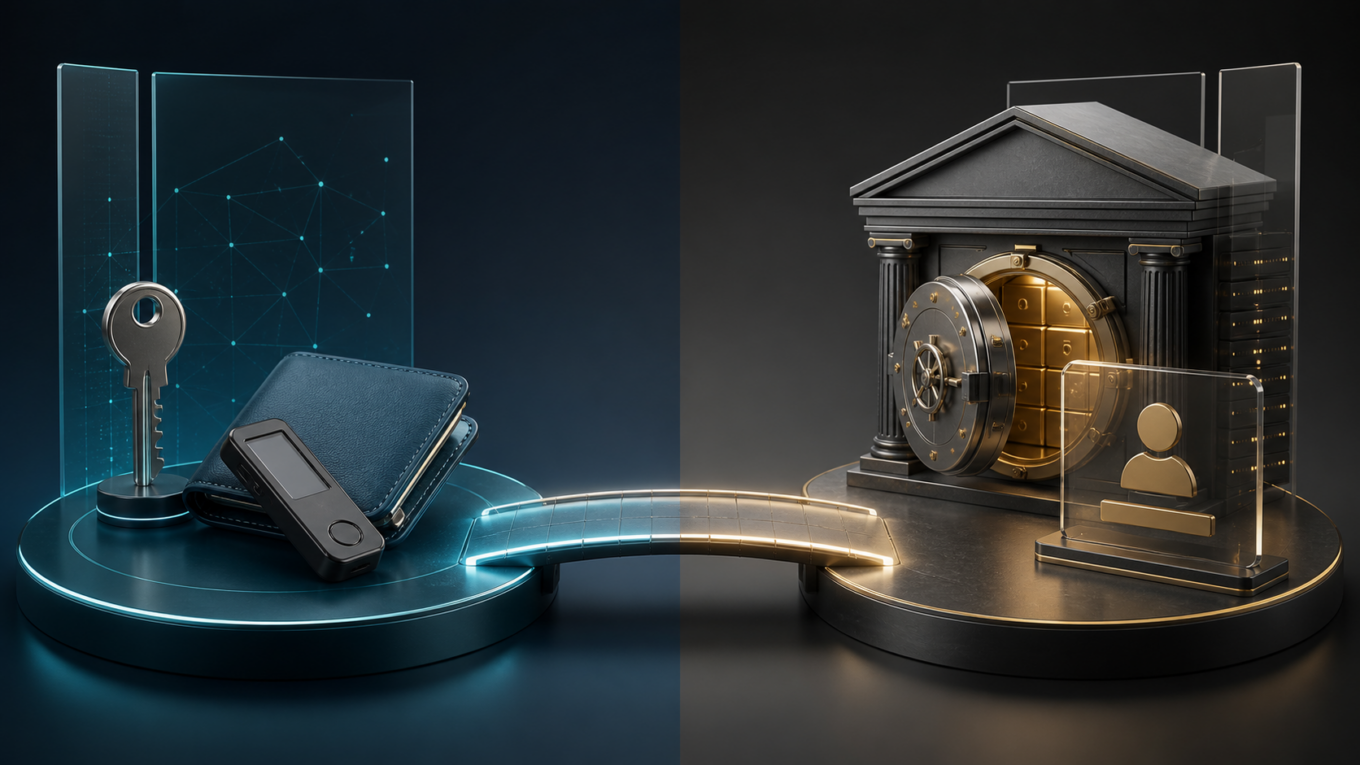
Self-Custody vs Crypto Banks: Where Will Users Keep Their Money?
People who own crypto face a basic custody decision: hold assets in a wallet they control or leave them with a centralized provider that manages access on their behalf. The first model is self-custody. The second is sometimes described as a “crypto bank,” although most exchanges and custodians are not banks and do not necessarily provide the same protections as a regulated deposit account.
The choice is not simply freedom versus convenience. Each approach assigns responsibility differently. Self-custody gives the owner direct control over transaction signing, while a centralized service manages keys, account recovery, and much of the operational complexity. The better fit depends on purpose, security habits, transaction frequency, and need for support.
What self-custody gives users
In a self-custodial wallet, authority rests with the credentials that sign transactions. This lets the owner move assets without asking a platform to approve each withdrawal. It also enables direct interaction with blockchain applications and reduces exposure to a custodian’s insolvency, withdrawal freeze, or account restriction.
That independence comes with a hard trade-off: there may be no help desk capable of restoring lost recovery information. A copied seed phrase, malicious signature, compromised device, or transfer to the wrong network may lead to permanent loss. Self-custody is strongest when key management is treated as a serious operational task rather than a one-time setup screen.
Current wallet catalog data illustrates the approach. Bitget Wallet is identified as self-custodial and available through mobile apps and a browser extension, while supporting activity across many blockchain networks. This kind of product provides broad access, but every additional network, token, and application creates more decisions about contracts, approvals, and transaction routes.
What centralized platforms provide
A centralized exchange or custodian holds the signing infrastructure and presents customers with an account. Password resets, customer support, familiar transaction histories, and integrated trading may make the experience easier. A current exchange profile for Bitget, for example, classifies it as centralized and shows how one login combines markets with other financial products.
Centralization is useful for active trading, conversion between assets, or people who are not ready to manage recovery credentials. The provider may also offer safeguards such as withdrawal checks and security alerts. These features reduce certain customer errors, but they do not remove risk; they move a large part of it to the institution.
Customers must consider how the provider stores assets, separates funds, handles withdrawals, responds to attacks, and operates under local rules. A displayed balance is a claim within the platform’s system until the assets are withdrawn on-chain. Access may be delayed by maintenance, compliance review, regional restrictions, or a wider service failure.
A hybrid model is likely to persist
Many people will not choose one side permanently. A practical arrangement separates money by purpose. Funds needed for trading or short-term conversion may stay on a centralized platform, while longer-term holdings move to self-custody. A smaller mobile-wallet balance may cover routine on-chain activity, with a separate device or signing setup used for higher-value storage.
This approach limits the impact of a single failure. If one account is locked, one device is compromised, or one smart contract receives a dangerous approval, the entire balance is not necessarily exposed. The trade-off is more complexity: owners must track several addresses, recovery methods, tax records, and transfer fees.
The hybrid approach also reflects a broader product trend. Centralized providers are adding wallet-like features, while self-custody wallets are integrating swaps, purchase routes, and payment tools. Interfaces may look similar even when the legal and technical custody structure is very different. People should focus on who authorizes a transaction and who restores access, not merely on the app’s design.
Questions to ask before choosing
A custody decision becomes clearer after answering a few concrete questions:
- Who controls the signing keys or recovery credentials?
- Can the provider delay or refuse a withdrawal?
- What happens if the phone, password, or recovery phrase is lost?
- Is the balance intended for trading, payments, or long-term holding?
- Which protections apply in the user’s jurisdiction?
- How will records, inheritance, and emergency access be handled?
Security claims should be tested against the actual setup. A hardware device is not helpful if its recovery phrase is stored carelessly. A reputable custodian is not enough if an attacker takes over the owner’s email and bypasses weak account controls. The safest structure is one that can be operated consistently.
Key takeaways
Self-custody offers direct control and open blockchain access, but it makes the owner responsible for keys and transaction decisions. Centralized platforms simplify access and support, but they introduce institutional, account, and withdrawal risk. Most people are likely to combine both models, assigning different balances to different purposes.
Where people keep their money will depend on whether products can make responsibility visible. Clear custody terms, strong recovery design, sensible transaction controls, and honest explanations of failure scenarios matter more than slogans about independence or convenience. This article is informational and not financial advice.